
When you search for fresh-made juice near you, you get juice bars, bottled brands, and powdered mixes that all claim to be real juice. If you cannot tell what you are actually paying for, this breaks it down clearly.
The short answer: fresh-made juice is prepared from real fruit at the moment you order it, while concentrate juice is reconstituted from a processed base with water added back in.
That difference affects nutrition, flavor, and price, and it explains why one option costs more per glass than the other.
“The 2024 International Food Information Council (IFIC) Food & Health Survey found that 39 percent of U.S. consumers said ‘fresh’ best defines a healthy food, making it the most commonly selected definition.”
Fresh-pressed juice suits you if you want maximum flavor and real ingredients. Concentrate suits shoppers who prioritize shelf life over freshness.
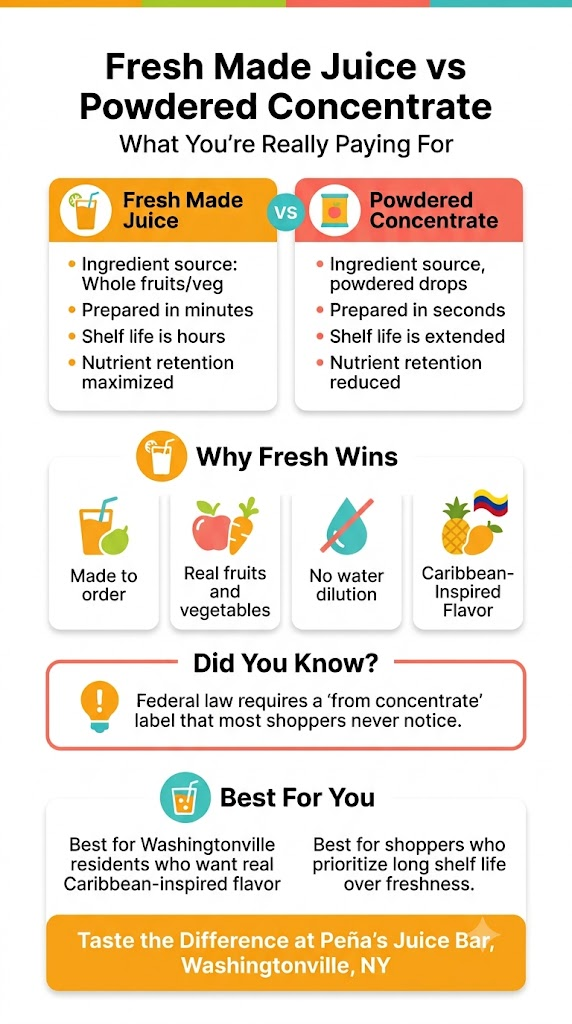
Quick Comparison: Fresh-Made Juice vs Powdered Concentrate
Fresh-made juice and powdered concentrate solve different problems for different buyers.
Here is how they stack up on the factors that actually matter to your glass and your wallet.
| Factor | Fresh-Made Juice | Powdered Concentrate |
| Ingredient source | Whole fruits and vegetables | Concentrated base plus added water |
| Preparation timing | Made the moment you order | Mixed in advance or reconstituted on demand |
| Shelf life | Short, meant for immediate drinking | Long, built for storage |
| Nutrient retention | Higher, no processing delay | Lower, reduced during concentration |
| Labeling requirement | No disclosure needed | Must state “from concentrate” |
| Price driver | Real ingredient cost | Processing and packaging efficiency |
What Pena’s Fresh-Made Juice Delivers
Every juice and smoothie at Pena’s Juice Bar is prepared to order, using real fruits and vegetables, never pre-made and never bottled.
That single standard shapes everything else on this list, from nutrient content to the Caribbean-inspired flavor you actually taste in the glass.
Choosing a juice bar built around made-to-order preparation means you get the benefit of that standard every single time you order, not just on a good day.
1. Made-to-Order Means Nothing Sits and Loses Nutrients
Juice loses vitamins the longer it sits after cutting or pressing. Pena’s avoids that entirely by preparing your drink only after you place your order, so nothing sits in a pitcher or a bottle waiting for a buyer.
That is the mechanism behind the freshness claim, not just a slogan you see on a menu board.
2. Real Fruits and Vegetables, No Water Dilution
Concentrate production removes water from juice, then adds it back later during reconstitution. Pena’s skips that step completely. Your blend comes straight from whole produce, so you get the ingredient ratio the fruit started with, not a diluted version built to survive a shelf for months.
3. Caribbean-Inspired Blends You Can’t Get From a Powder Mix
Pena’s signature drinks bring authentic Dominican and Puerto Rican flavor combinations to Washingtonville, built fresh for each order.
A powdered mix cannot replicate that complexity, because concentrate formulas are built for consistency and shelf stability, not layered, culturally rooted flavor profiles that change the whole drinking experience.
Customers who have tried the difference describe it directly. One Google reviewer, Mickey Walker, wrote:
“Hands down some of the best Dominican and Puerto Rican food I’ve had in a long time. The flavors were incredible.”
Another reviewer, Gilma Kelly, said:
“This place is amazing! The food and drinks felt authentic, with a few creative twists that made everything even more exciting.”
Reactions like these are what real ingredients and made-to-order preparation produce, not what a reconstituted mix typically earns from a first-time customer.
What Powdered Juice Concentrate Offers
Powdered and concentrate juice products are built for convenience and shelf stability rather than immediate freshness.
Manufacturers concentrate juice by removing water, then package it for long-term storage, and retailers or consumers reconstitute it later by adding water back before drinking.
Federal labeling rules require this process to be disclosed clearly on the package.
“Under 21 CFR 102.33, any beverage made from concentrate must include a term such as “from concentrate” or “reconstituted” on the label, so shoppers can identify it at a glance.” (21 CFR 102.33, Cornell Law)
This approach works for buyers who value a long pantry life over drinking something made minutes ago.
The Key Differences That Matter
The real decision comes down to two factors: how the product is made, and whether you notice what the label is actually telling you before you buy it.
Yes, Concentrate Lasts Longer on a Shelf, But That Convenience Has a Cost
Concentrate juice offers a longer shelf life and a lower unit cost, which matters if you are stocking a pantry for weeks at a time. That stability comes from processing and water dilution, which means you trade nutrient density and fresh flavor for storage convenience.
If freshness is your priority, that tradeoff works against you every time you pour a glass.
The FDA “From Concentrate” Label Most Shoppers Never Notice
“Federal law requires concentrate-based beverages to disclose that fact on the label, under 21 CFR 102.33 (21 CFR 102.33, Cornell Law), and the FDA Food Labeling Guide confirms this disclosure applies across juice categories, carbonated and non-carbonated alike.” (FDA Food Labeling Guide)
Most shoppers walk past this disclosure without reading it closely, which means many people drink reconstituted juice while believing it sits closer to fresh than it actually does.
Understanding this labeling rule helps you make an informed choice instead of guessing based on the packaging alone.
Which Option Is Best for You?
Powdered concentrate is best for shoppers who need a long shelf-stable fresh-made juice and are comfortable with reconstituted, water-diluted juice as a tradeoff for convenience.
Pena’s fresh juice is best for Washingtonville residents and health-focused buyers who want real, made-to-order Caribbean-inspired flavor without shortcuts and who are willing to visit or order for that freshness every time.
Frequently Asked Questions (FAQs)
Q1. Is fresh-made juice healthier than juice made from concentrate?
Fresh juice generally retains more nutrients because it skips the concentration and reconstitution process, which can reduce vitamin content along the way from farm to glass.
Q2. Does Pena’s Juice Bar use any powdered or concentrate ingredients?
No. Every juice, smoothie, and custom blend at Pena’s is made from real fruits and vegetables at the moment you order, never pre-made and never bottled at any point.
Q3. What does “from concentrate” mean on a juice label?
It means the juice was concentrated by removing water, then reconstituted later by adding water back before packaging or serving it to you.
Q4. How fast is fresh-made juice prepared at Pena’s?
Your drink is prepared after you place your order, whether you walk in, call ahead, or use the online order form, so it reaches you freshly made rather than sitting premade on a shelf.
Order Fresh-Made Juice the Way It Should Be Made
Fresh, made-to-order juice gives you real ingredients, better nutrient retention, and Caribbean-inspired flavor you cannot get from a reconstituted mix.
If you are ready to taste the difference, visit Pena’s Juice Bar in Washingtonville, place your order online through the website, or call ahead so your drink is ready fresh when you arrive.
